
Protein is the gap that does not show on a blood test and shows everywhere else: in the hunger an hour after a large bowl of vegetables, in the recovery that takes three days instead of one, in hair and nails, and in the slow, quiet loss of muscle after forty that most women put down to age. It is also the gap with the best news. Matched gram for gram, plant protein builds and keeps muscle exactly as well as animal protein in the trials that bothered to match it. The problem is never that plants cannot do it. It is that a plant-based plate drifts to 50 g a day without anyone noticing, when the woman eating it needs 90.
The signs protein is low
- Hunger within an hour of a meal that looked enormous; constant grazing on carbohydrate.
- Soreness that lingers for days after training; strength that does not progress.
- Hair shedding, nails that peel, skin that heals slowly.
- A body that feels softer at the same weight; clothes that fit differently.
- More colds, slower bounce-back, swelling at the ankles by evening in more severe cases.
There is no useful blood marker for this gap. The three-day log is the test, and it is accurate.
How much you need
| Reference | Amount | For a 65 kg woman |
|---|---|---|
| EFSA population reference intake, adults | 0.83 g per kg a day | 54 g |
| US RDA | 0.8 g per kg a day | 52 g |
| Older adults, PROT-AGE position paper | 1.0 to 1.2 g per kg a day | 65 to 78 g |
| Women who train, the meta-analysis plateau | up to 1.6 g per kg a day | 104 g |
| A practical target for a woman over forty on plants | 1.2 to 1.6 g per kg a day | 78 to 104 g |
| Per meal, to trigger muscle building | 25 to 30 g, with 2.5 to 3 g leucine | three times a day |
Plant proteins are digested a little less completely and are lower in leucine, the amino acid that switches muscle building on, which is why the practical target sits at the upper end of the range rather than the EFSA floor. Spreading it evenly matters as much as the total: three meals of 30 g build about 25 percent more muscle over a day than the same protein skewed into dinner.
Plant proteins, grams per portion
| Food | Portion | Protein | Leucine |
|---|---|---|---|
| Seitan | 100 g | 25 g | 1.8 g |
| Tempeh | 100 g | 19 g | 1.5 g |
| Lentils, cooked | 200 g | 18 g | 1.3 g |
| Firm tofu | 150 g | 17 g | 1.4 g |
| Edamame, shelled | 1 cup (155 g) | 17 g | 1.4 g |
| Soy milk | 250 ml | 7 to 8 g | 0.6 g |
| Chickpeas, cooked | 200 g | 15 g | 1.1 g |
| Black beans, cooked | 200 g | 17 g | 1.4 g |
| Hemp seeds | 30 g | 9 g | 0.6 g |
| Pumpkin seeds | 30 g | 9 g | 0.7 g |
| Oats, dry | 60 g | 8 g | 0.6 g |
| Peanut butter | 30 g | 8 g | 0.6 g |
| Quinoa, cooked | 200 g | 8 g | 0.5 g |
| Pea protein powder | 30 g scoop | 22 to 25 g | 2.0 g |
| Soy protein powder | 30 g scoop | 25 g | 2.1 g |
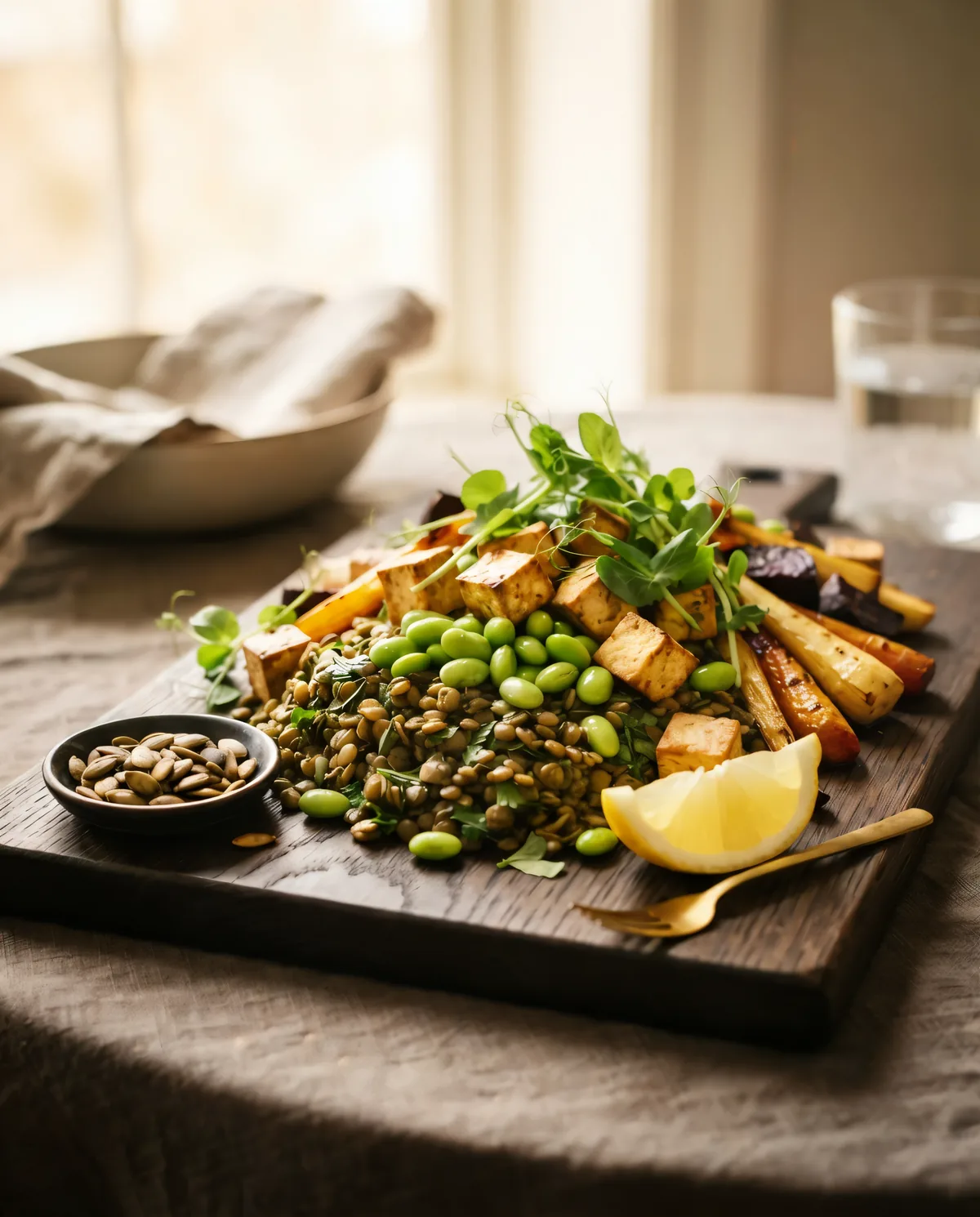
Three meals that each reach 30 g without a powder: soy milk porridge with hemp and pumpkin seeds; a lentil and tofu bowl; tempeh with black beans. Soy foods and seitan are the heavy lifters; the rest fill in around them.
The rules that make plant protein work
Anchor every meal on soy, lentils, beans or seitan. Vegetables and grains are the garnish, not the protein. A meal without one of the anchors is a snack.
Reach 25 to 30 g three times a day, including breakfast, which is the meal plant eaters skip on protein. Porridge made with soy milk instead of oat milk adds 7 g for nothing.
Pair a legume with a grain across the day. Lysine is low in grains and methionine low in legumes; eating both in the same day, not necessarily the same meal, covers it.
Leucine first after training. Within a couple of hours of a strength session, 30 g from soy, pea or a mix gets you to the 2.5 g leucine that opens the gate.
Powder is a tool, not a failure. A scoop of pea or soy protein in the morning oats is the single easiest way to add 20 g on a day that is already going wrong.
Count it for three days. A kitchen scale and a free app; most women find the total is 20 to 40 g short and that the shortfall is all at breakfast and lunch.
The one-week fix
- Make the household milk soy. It is the only plant milk with meaningful protein.
- Put a legume or a soy food on the plate at every meal, including breakfast.
- Keep a block of firm tofu and a bag of frozen edamame in the house at all times; they are the fifteen-minute rescue.
- Log three days this week, weighed, and compare to 1.2 g per kilo. Add a scoop of pea protein to breakfast until the log says you are there.
- Lift something heavy twice this week; protein without a reason to use it goes nowhere.
What the research says
- Hevia-Larraín and colleagues, Sports Medicine, 2021, randomised trial of 38 young men: leg lean mass and strength gains over twelve weeks of training did not differ between a high-protein plant-based diet and a protein-matched omnivorous diet. The contrary finding: both groups were given enough protein, 1.6 g per kg, so the trial says nothing about plant diets that fall short of that. doi.org/10.1007/s40279-021-01434-9
- Morton and colleagues, British Journal of Sports Medicine, 2018, meta-analysis of 49 randomised trials with 1,863 participants: adding protein to resistance training increased one-repetition-maximum strength by 2.49 kg and fat-free mass by 0.30 kg beyond training alone, with benefits plateauing beyond about 1.6 g per kg a day. The contrary finding: the effect shrank with age, so older adults may need the same amount for a smaller return. doi.org/10.1136/bjsports-2017-097608
- Mamerow and colleagues, Journal of Nutrition, 2014, randomised crossover trial in eight adults: 24-hour muscle protein synthesis was about 25 percent higher when 90 g of protein was spread evenly over three meals than when it was skewed toward dinner. The contrary finding: eight people, one week, and the protein was animal; the pattern is well supported but this trial is small. doi.org/10.3945/jn.113.185280
- Bauer and colleagues, Journal of the American Medical Directors Association, 2013, PROT-AGE expert position paper: older adults need more than the 0.8 g per kg RDA to maintain muscle, with 1.0 to 1.2 g per kg and 25 to 30 g per meal suggested. The contrary finding: it is an expert consensus, not a trial, and it was written about people over 65. doi.org/10.1016/j.jamda.2013.05.021
Questions women ask
Is 50 g a day enough? For a sedentary woman of 60 kg, it meets the EFSA floor. For a woman over forty who wants to keep her muscle and train, it is 30 to 50 g short.
Do I have to combine proteins at every meal? No. Across the day is enough. Across the meal is just easier when the meal has soy or lentils in it anyway.
Will more protein hurt my kidneys? Not healthy kidneys, at these amounts; the trials above ran at 1.6 g per kg without harm. Anyone with kidney disease needs a clinician’s number, not this page.